

The Biola Bell Tower near the center of Biola’s campus holds five iconic bells from a historic set from 1914.
By Brad Layland | Chief Executive Officer & Senior Consultant
Key Takeaways
- Celebrate the legacy of ordinary, devoted servants whose faithful lives built the foundation of your ministry.
-
Use plaques and donor displays to keep inspiring stories of quiet, lifelong ministry service alive for future generations.
“And whatever you do, whether in word or deed, do it all in the name of the Lord Jesus, giving thanks to God the Father through Him.” – Colossians 3:17
“But when you give to the needy, do not let your left hand know what your right hand is doing, so that your giving may be in secret. Then your Father, who sees what is done in secret, will reward you.” – Matthew 6:3-4
To plaque, or not to plaque—that is the question. Whether it is nobler to etch names upon brass and marble, or to let lives speak only through the quiet echoes of memory.
Twice now, in my career, I’ve stumbled upon hidden plaques that told stories nearly forgotten. And both times, they reminded me that the truest honor is not measured in dollars, but in devotion.
The Rediscovery of Ethel Maude Lee
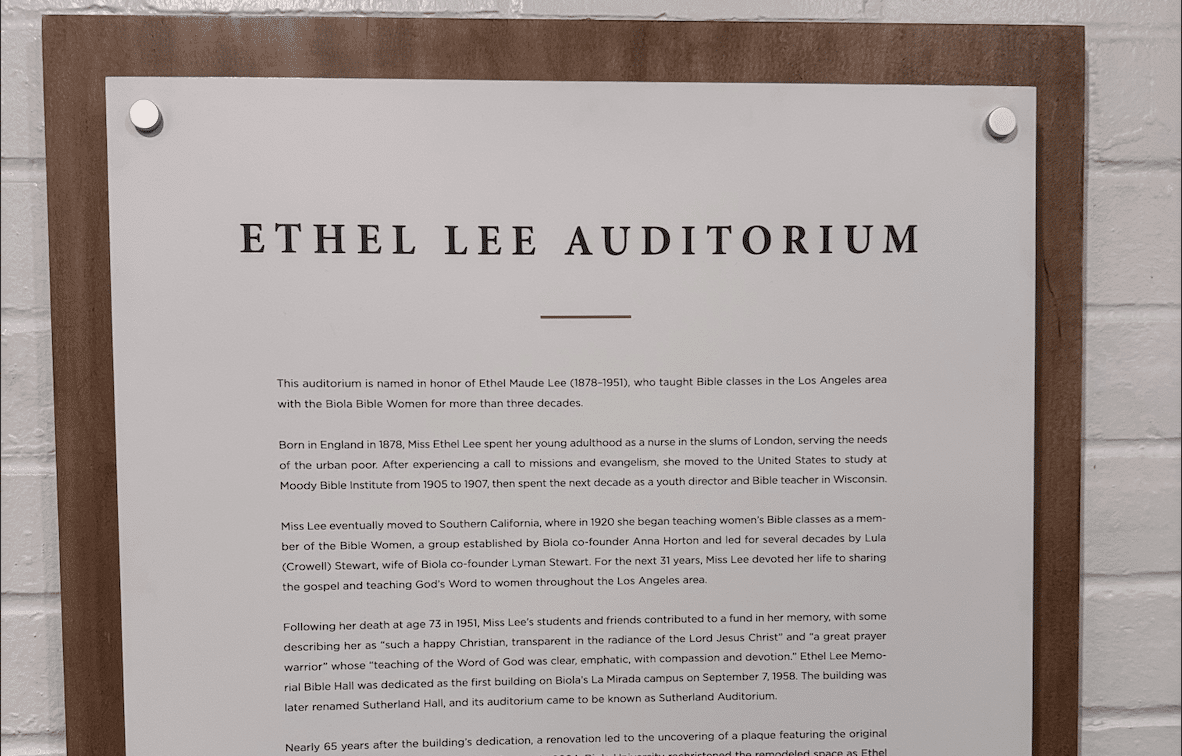
During Biola University’s renovation of its oldest auditorium, construction crews peeled back a mural and found a plaque concealed for decades. It read:
“We dedicate this auditorium to the glory of our Lord Jesus Christ in loving memory of Ethel Maude Lee (1878–1951), Biola Bible Woman, 1920–1951.”
Most knew the space as “Sutherland Auditorium.” Few remembered it had once been dedicated to a woman whose life was poured out in service to Christ.
Ethel Maude Lee was born in England in 1878 and began her ministry as a nurse in the London slums. Sensing a deeper call, she came to the U.S., studied at Moody Bible Institute, and spent years teaching scripture in Wisconsin.
In 1920, she joined Biola’s “Bible Women”—a team who taught the Word across Los Angeles. For 31 years, she opened the Scriptures with compassion and conviction, described by her students as “a happy Christian, transparent in the radiance of the Lord Jesus Christ,” and “a great prayer warrior.”
When she died in 1951, friends and students raised funds to build an auditorium in her honor. Over time, her name was lost—but the plaque, quietly waiting, kept her story alive. In 2024, Biola restored her name, rechristening the space the Ethel Lee Auditorium. As President Barry Corey said, “The name Ethel means ‘noble’ and what more noble calling is there than to teach and proclaim scripture to a needy world.”
A Virginia Plaque
Years earlier, while serving a small Christian school in Virginia, I found another plaque. It, too, honored not the wealthy or the powerful, but the faithful—teachers and servants who gave their lives to Christ’s mission. Their names might have faded from living memory, but the plaque called them back to us.
Why Plaques Matter
Both of these plaques share something in common: they weren’t about gift levels. They were about faithfulness to Jesus.
Now don’t get me wrong—donor walls matter. They honor generosity and inspire others to give. But these plaques pull us deeper into our walk with the Lord. They whisper that the greatest gift isn’t financial; it’s a life laid down for the Lord, which encompasses far more than the size of our gifts.
And so, back to our question: to plaque or not to plaque? I say: plaque! But let our plaques not merely count gifts; let them also proclaim faithfulness. Let them remind us that the highest calling is not wealth or recognition, but to give our lives away, wholly and joyfully, to Jesus Christ.
At the end of the day, our money may build buildings, but our faithfulness builds legacies. And for that, I’m grateful that both Biola and a little school in Virginia chose to plaque.
[Sources for this article include Biola University publication Honoring Ethel Maude Lee, a Dedicated Biola Bible Woman (2024) and A Hidden Plaque, a Forgotten Heroine: The Rediscovery of a Legacy of Faith (Biola Magazine, 2025).]
We’ve been privileged to help many organizations be more effective in their fundraising by learning and implementing relational fundraising principles in their work with donors. Want to talk?