

By Howard Freeman, Senior Consultant & Director of Research
Key Takeaways
- AI should serve relationships, not replace them. Our Taking Donors Seriously® first principles continue to guide all of our work.
- The quality of your AI output depends on the quality of your prompt. Define the AI’s role, the scope of the task, and the exact output you want.
- Save your own voice for donor-facing narrative writing. Readers can tell the difference, and AI-generated content is quickly saturating channels like LinkedIn.
- Most nonprofits use AI only to draft content. Very few use it for predictive or agentic fundraising work, the areas with the greatest untapped ROI.
I remember it distinctly: my first significant experience of using AI. It was May 2024, and I was frequently driving a five-hour commute between a client’s office in Dallas and my home in the Texas hill country. When ChatGPT released its advanced voice mode, I started using it during my long drives.
I interacted with it to have conversations about business strategy. I used it to dictate documents. When I got home, I would edit or polish what I’d worked on while driving. As the months rolled by, I got better at using it. I was consistently impressed by its ability to accelerate my work by serving as an assistant and a thought partner.
By April 2025, I’d become deeply interested in how else this technology could serve ministries, specifically in prospect research, one of the most time-consuming and expensive parts of development work, yet one with a clear ROI. That curiosity eventually led me to develop Rōmy, an AI-powered prospect research tool. I’m glad to share that The FOCUS Group recently acquired Rōmy. (You can read the full story in our official announcement.) Still, the short version is this: it aims to put serious research capability directly into the hands of your development team, freeing you up to continue to invest in real relationships with your donors.
Through personal use as well as overseeing the development of an AI-based tool, I’ve had many opportunities to explore some of the best (and worst) ways to deploy AI. Here are a few of my current takeaways every nonprofit leader should know when considering how to best deploy AI in your work.
Before I get into the practical stuff, it’s worth naming the lens I’m running all of it through. Everything we teach at The FOCUS Group is built on our Taking Donors Seriously® fundraising system, and its very first principle is this: people give to people they know and trust. That principle remains true, regardless of technological advances. It has also become the test I run every new tool through: does this technology deepen the relationship with a donor, or does it quietly get in the way? Everything below is my attempt to answer that question honestly.
Master the Prompt
Early in my career, I tried and rapidly failed at three successive sales jobs: time management seminars, retail furniture, and Electrolux vacuum cleaners. But along the way, one of my managers shared some wisdom that would pay off when I started using AI thirty years later. It’s advice that may also help you navigate this brave new world:
“You must become a Master Question Asker.”
(I would add Master Listener as a necessary companion skill.)
When alone in front of your computer, remember that, in the ways that matter most, you are the smartest person in the room. Let that sink in. At your fingertips you have access to a myriad of incredibly intelligent entities, but they are helpful only to the extent that you direct them wisely. Your “prompts” are the tools you use to guide them toward your intended destination.
Which means you need to think more clearly than ever.
When using an AI’s chat feature, be specific about the role you want it to play and the exact output you’re looking for. For example, let’s say you want to find out information about one of your newest major gift partners named Jane Smith:
- Define your AI’s role. “You are a 30-year-veteran prospect researcher working at a top American research university.”
- Define the scope of work. “Please find information from publicly available records on Jane Smith’s assets, business background, and philanthropic history. Jane lives at 123 Main Street in Anytown, Ohio. We want to engage her further in our mission of feeding the homeless in Cincinnati.”
- Define what kind of output you want. “In no more than three letter-sized pages, give me (1) an executive summary on Jane, (2) a list of her and her spouse’s assets and bullet points for business bio and philanthropic background, and (3) recommended actions to take for engaging Jane in our mission. Our nonprofit’s website is www.HighImpactNonprofitInOhio.org. Use language that is concise and professional. I want to give this to one of our board members.”
The more specific and comprehensive your prompt, the better your result and, ultimately, the more time you’ll save.
Minimize the Use of AI To Generate Narrative Content
Do you still read LinkedIn posts?
Generally, I don’t. A 2026 analysis by the AI-detection firm Pangram found that more than 40% of LinkedIn’s long-form posts are now flagged as fully AI-generated—more than any other platform they studied.
As pro-AI as I am, I am becoming less enchanted with one of its most frequent uses: generating content.
I’m drafting this on a plane, and while I don’t know how much will be edited later, I do know that, as I write, I am thinking about you, the reader. I am brainstorming, evaluating, and distilling my thoughts into the key elements I want to share that I believe will help you do your very challenging and Kingdom-impacting work. I believe the “why” behind this writing matters. There is something about me (a human) conveying words to you (another human) that is uniquely valuable and, frankly, irreplaceable.
Don’t you absolutely love a good novel? Have you received a letter from someone that you have kept safe and taken out from time to time to read again? Does reading an historic speech move you to tears? We humans can often be moved by the Holy Spirit to write and speak words that have stood the test of time.
So here’s my challenge: When possible, draft your monthly donor update or annual report letter in a word processor or, better yet, use pen and paper.
My favorite Bible verse (Ephesians 2:10) starts, “For we are [God’s] workmanship…” The word “workmanship” is the Greek word poiēma, from which, of course, we get our word “poem.” Your words, inspired by God, can move your donor to action. As a missional leader, you want your donors to hear your heart. They want to be able to trust you. When donors feel they can trust your organization, this can lead to increasingly large gifts, and maybe even make a bequest to your organization. They need to know you. Sharing your heartfelt writing is the best way to further that relationship.
And writing a first draft yourself, especially in longhand, will actually be a gift to you as well. You will slow down to think deeply on behalf of your donors.
Protect (And Grow!) Your Relationships
In an age where efficiency is paramount, investing in relationships matters more than ever. As I said at the outset, that first TDS® principle—people give to people they know and trust—is the test I keep coming back to. The truth of that statement is as relevant as ever.
According to the 2025 Nonprofit Tech for Good survey, only 3% of nonprofits use AI-powered real-time fundraising intelligence, and only 2% use agentic AI software in their fundraising work. At the same time, generative AI (drafting emails, letters, and social posts) has become the default entry point for most organizations. Those less-adopted functions have potentially much greater impact and ROI than generative AI alone. Not only that, but poorly executed generative AI can actually undermine the relationships that matter most.
As you find ways to efficiently use AI (more often for donor research, analysis, agentic workflows, and other data-heavy tasks), you will begin to see real-time savings. As AI makes your work more efficient, spend that additional time investing in your donors who partner with you to do the work of your ministry.
You can continue to build trust with your donor community as you embrace transparency when it comes to AI use. I’d strongly recommend writing an AI policy (and for this, I wholeheartedly endorse using AI!). It will show stakeholders how you’re using this technology to make you and your staff more efficient, so you can spend more time advancing your mission and letting your supporters know the impact they’re having in their community.
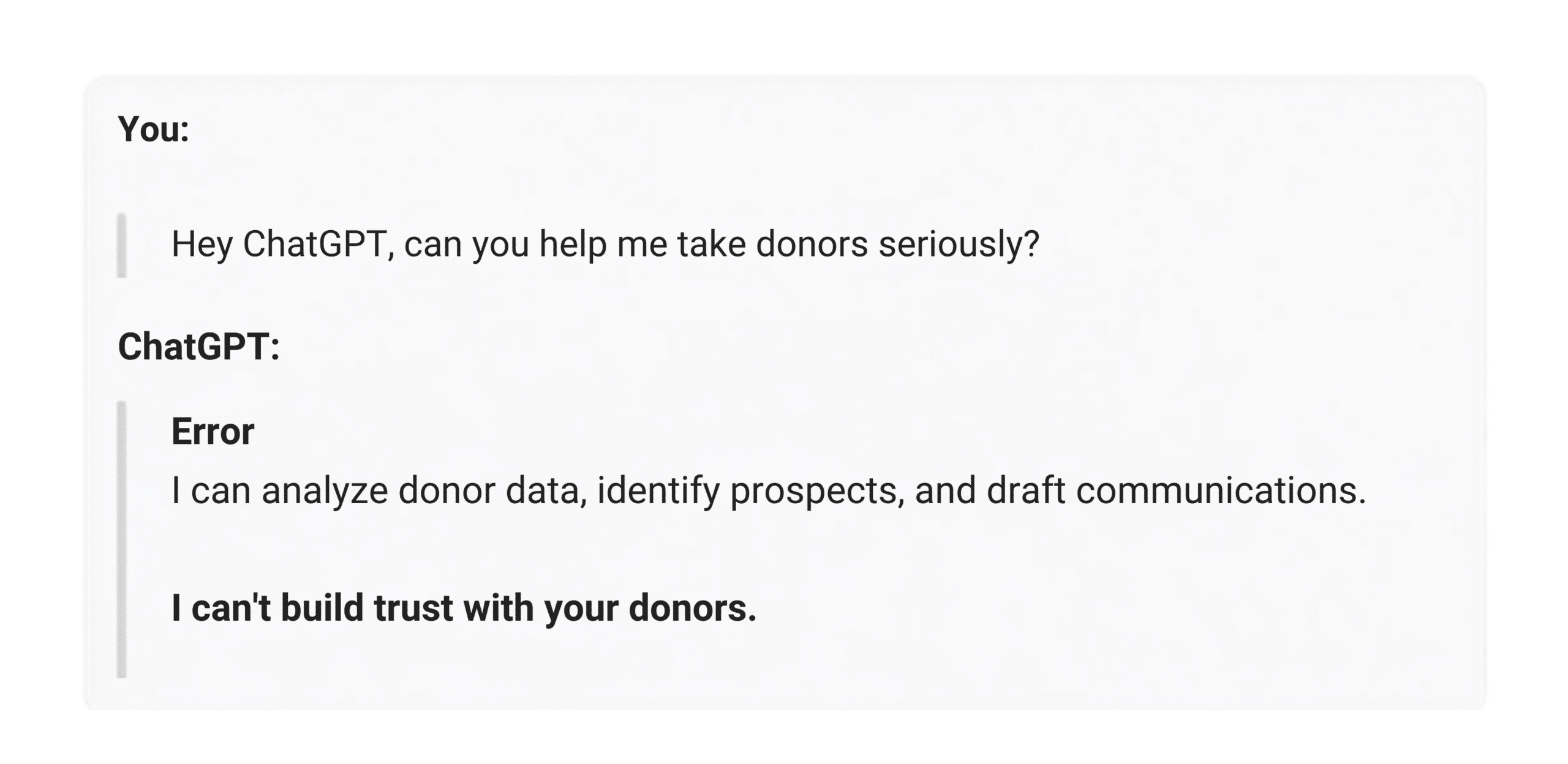
To sum up: AI might be a better mousetrap, but let’s make sure we’re using it to trap mice. It will never (nor should you expect it to) be the one to take your donors seriously. That, my friends, is the privilege and responsibility of us humans.
About the Author
 Howard Freeman is Director of Research and Senior Consultant at The FOCUS Group, bringing more than 30 years of fundraising experience across the nonprofit and private sectors. He has led development teams and capital campaigns for organizations including Gordon-Conwell Theological Seminary, Redeemer Presbyterian Church, and Young Life, and has also co-founded companies in climate technology and AI research. Howard has worked with The FOCUS Group in various capacities since 2000. He holds a bachelor’s degree in English from North Carolina State University and completed graduate studies at Gordon-Conwell Theological Seminary. He and his wife, Karen, live in Kerrville, Texas, and have three grown sons and two granddaughters.
We’ve been privileged to help many organizations be more effective in their fundraising by learning and implementing relational fundraising principles in their work with donors. Want to talk?